What cabinet installation costs in Santa Maria, CA
Installation runs about $100 per cabinet box on Thumbtack's national data, with removal of your existing cabinets at around $300 on top. A twenty box kitchen is therefore roughly $2,000 to install plus $300 to strip out, before any of the extras. Thumbtack also publishes roughly $70 per linear foot to remove old cabinets and install new, and a national average kitchen cabinet installation figure of $7,725, which includes supplying the cabinets rather than labour alone. Central Coast labour rates generally sit below Los Angeles and Bay Area rates.
| Item | Typical cost | Notes |
|---|---|---|
| Install per cabinet box | about $100 | The core labour figure. Multiply by your box count, not by linear feet. |
| Remove existing cabinets | about $300 | Have it written into the scope. It is the line most often assumed and least often quoted. |
| Remove old and install new | about $70 per linear foot | An alternative way the same work gets quoted. Check which method your quote uses. |
| Crown moulding | about $70 per 8 ft section | Priced by section, so a long run of uppers adds up quickly. |
| Finished ends | $100 to $200 each | Applies to any cabinet end that is visible rather than against a wall. |
Source: Thumbtack cost data, national figures. Use them to check a quote is in a sane range.
Install only, for cabinets you have already bought
Install only work is a normal, sensible way to buy this trade, and it is common when somebody has bought stock or semi custom cabinets from a big box store or a dealer and needs a real carpenter to hang them. The scope is different from a supply and fit job and the quote should say so.
- Confirm the box count and the sizes from the order before the quote, not on the day.
- Agree who receives and checks the delivery, and who is liable if a box turns up damaged.
- Agree whether removal and disposal of the existing kitchen is in scope, because it is the line most often assumed.
- Agree whether fillers, end panels, toe kick and crown are supplied with the cabinets or need to be made.
- Confirm that hinges and drawer slides came with the cabinets, since some flat pack ranges ship them separately.
- Agree who handles disconnection and reconnection of the sink, dishwasher and range, because that is plumbing and gas work with its own rules.
How a cabinet run is actually levelled
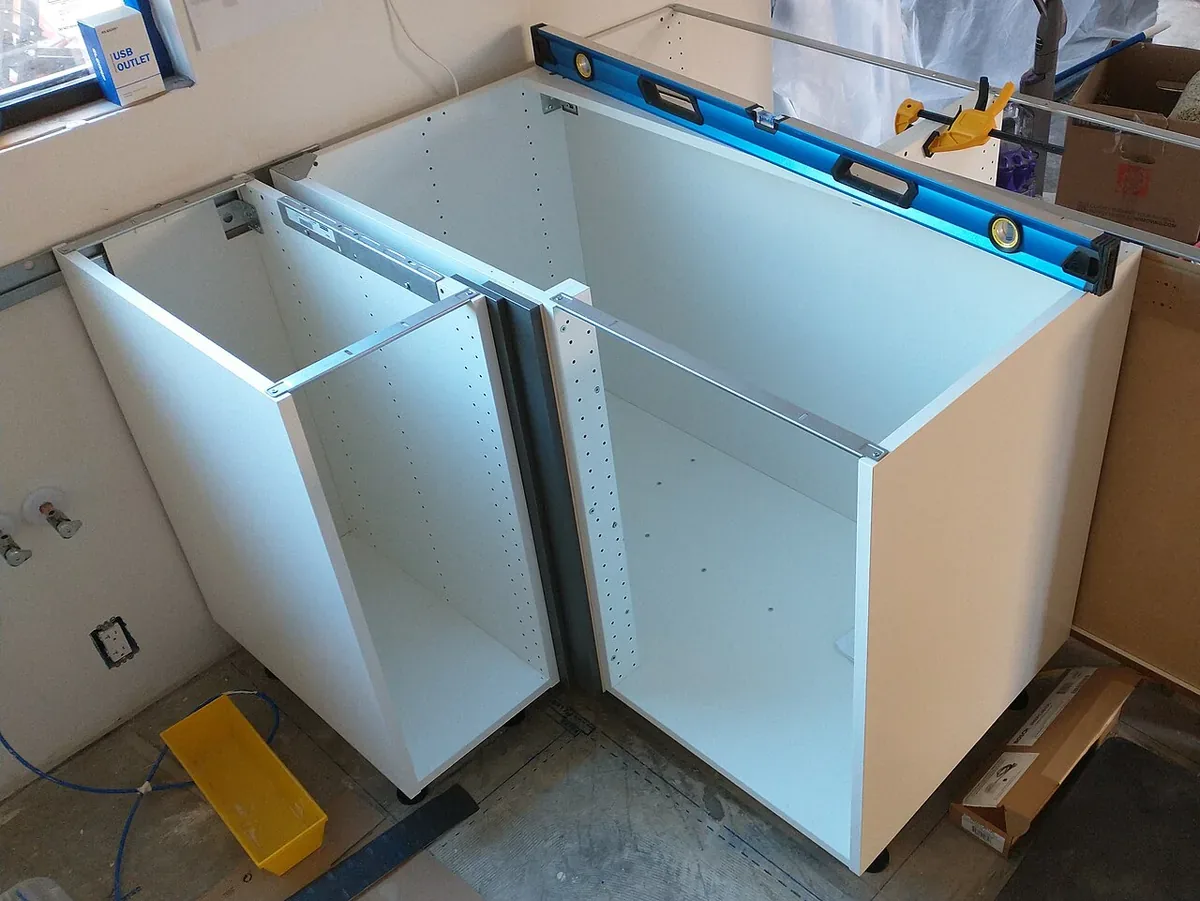
Everything hangs off one level line struck from the highest point of the floor. Kitchen floors in Santa Maria's older housing routinely run out by half an inch or more across a room, and if you start at a low point you will run out of shim before you reach the far end. So the first job is to find the high point with a long level or a laser, mark the base cabinet height from there, and carry that line around the room.
Fastening
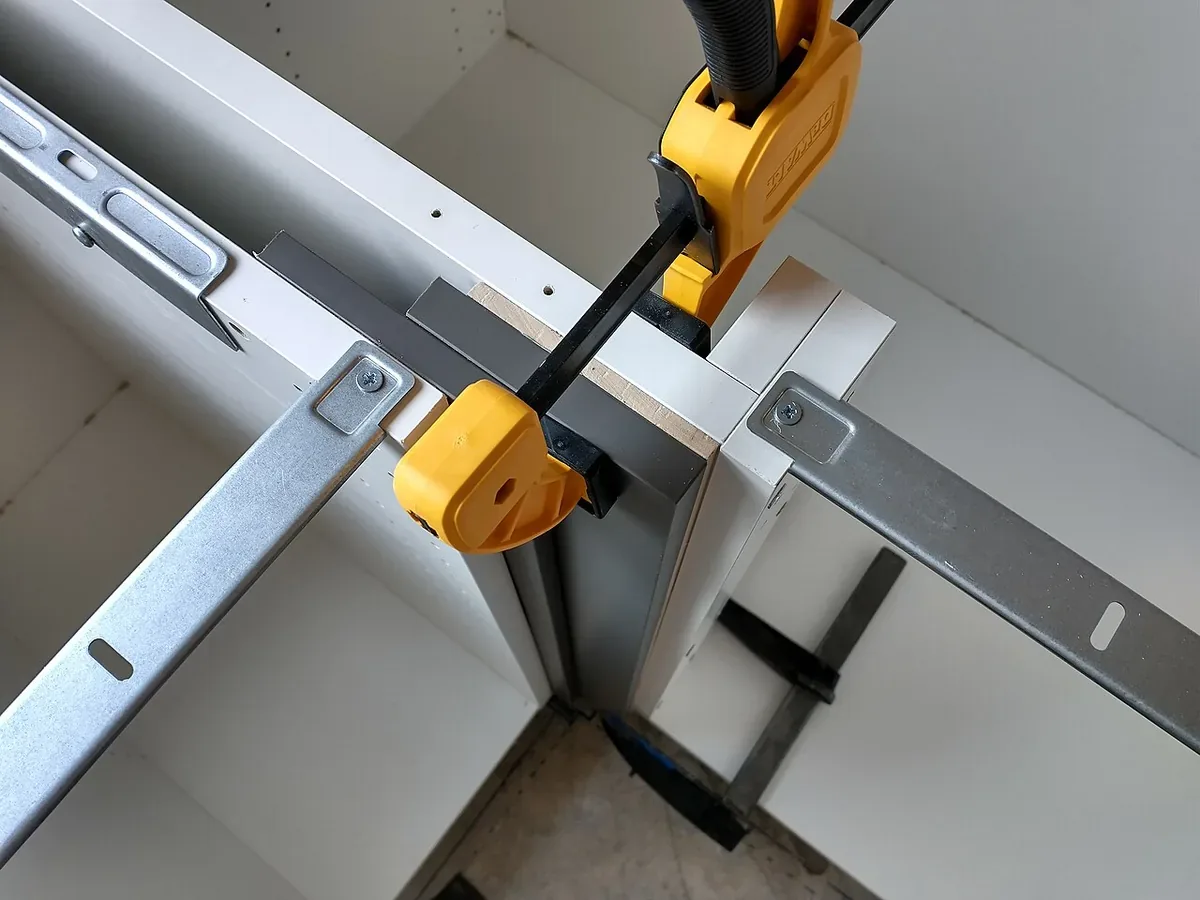
Cabinets are screwed to studs, not to drywall, and to each other. A wall cabinet carries its own weight plus everything you put in it through a hanging rail into framing. A base run is fastened at the back into studs and through the stiles into its neighbours, so the row acts as a single beam rather than a line of separate boxes. That is what stops doors drifting out of alignment a year later, and it is exactly what a rushed install skips.
Scribing
Walls are not straight, so the cabinet that meets the wall has to be cut to the wall rather than butted against it. Scribing means transferring the wall's actual profile onto the cabinet side or the filler and cutting to that line. In a mid century Santa Maria house with plaster or textured drywall this is the difference between a finished looking end and a tapering gap you cannot stop seeing.
Sequencing: what has to happen in what order
Uppers before bases, cabinets before counters, counters before the sink and the backsplash. Getting this order wrong is the main reason kitchen projects drift.
Counters deserve the clearest warning. Stone and quartz are templated off the installed cabinets, not off the drawing, and the fabricator needs the cabinets in place and level before they will measure. That means a gap of days between the cabinet install and the counter install, during which the kitchen has no working sink. Plan for it rather than being surprised by it, and confirm the fabricator's template lead time before the cabinets go in.
What triggers a permit on an installation
Hanging cabinets is exempt finish work, and the California Residential Code section R105.2 exempt list includes "painting, papering, tiling, carpeting, cabinets, counter tops and similar finish work" explicitly. The installation itself needs no permit.
What can need one is whatever else the job touches. Relocating the sink is plumbing. Adding under cabinet lighting or a new outlet is electrical. Moving a gas line for a range is gas work. Local jurisdictions can amend the exempt list, so a job with any of those in it should be confirmed with the City of Santa Maria Building Division, or Santa Barbara County Planning and Development if the property is unincorporated. Permit and licensing guide →
Licensing applies to install only work too
An install only job is still contracting. Business and Professions Code section 7048 exempts unlicensed work only where the aggregate contract price for labour, materials and all other items is under $1,000, the work is casual, minor or inconsequential, and no building permit is required. A twenty box install at roughly $100 per box is $2,000 of labour alone, so it needs a licensed contractor. The specialty classification is C-6, Cabinet, Millwork and Finish Carpentry, and a B General Building licence also covers it.
The contract rules follow: written and signed before work starts for anything over $500, and a deposit capped at $1,000 or 10 percent of the contract, whichever is less.
Installation across the Santa Maria Valley
Installation work runs across Orcutt, Nipomo, Lompoc and Guadalupe, with the full list on the service area page. If you have not bought cabinets yet, the kitchen cabinets and bathroom vanities pages cover supply and fit. When you are ready, request a written quote.