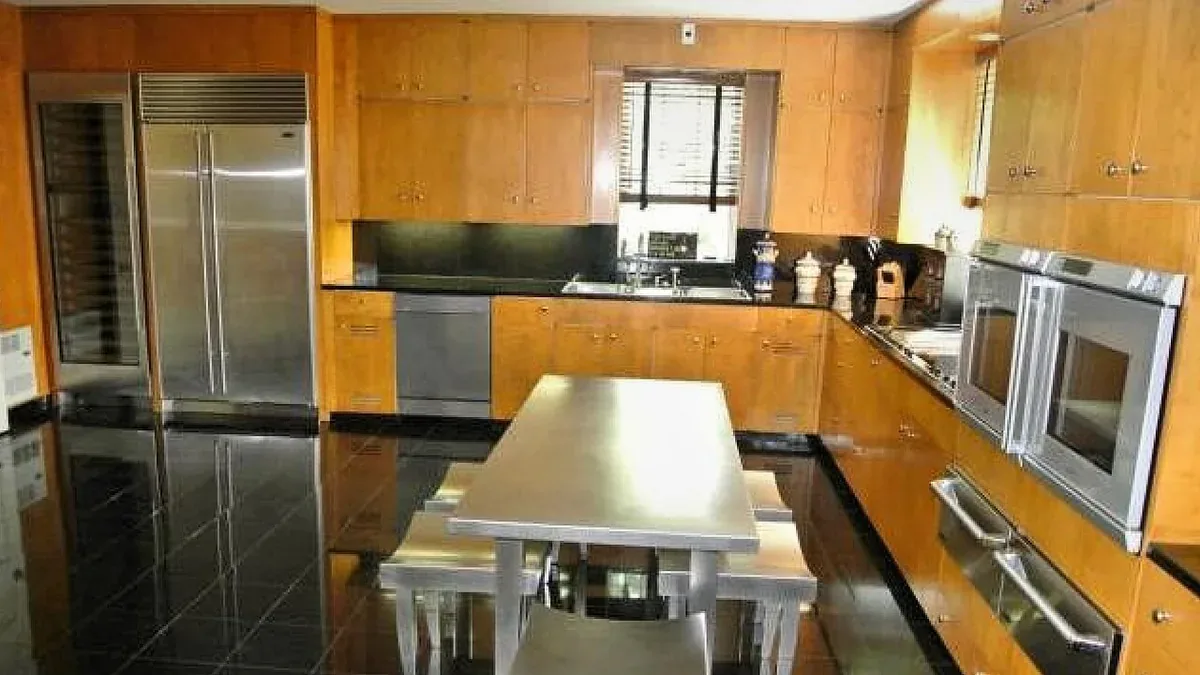
What a kitchen of cabinets costs in Santa Maria, CA
A full kitchen of cabinets runs $5,000 to $25,000 in solid hardwood, $1,900 to $13,000 in wood veneer and $4,000 to $15,000 in laminate, using Thumbtack's cost data for a standard sized kitchen. The spread inside each material comes from cabinet count and door complexity far more than from the species, since maple, cherry, oak and pine all sit in the same hardwood band. For a per linear foot cross check, California cabinet makers publish $500 to $1,200 per linear foot for custom work, and Central Coast labour generally runs below Los Angeles and Bay Area rates.
| Material | Standard kitchen | What it does well, what it does not |
|---|---|---|
| Solid hardwood | $5,000 to $25,000 | Best for face frames, door frames and drawer fronts. Wide solid panels move with humidity. |
| Wood veneer | $1,900 to $13,000 | Real wood face over a stable core. Cannot be sanded back more than once. |
| Laminate | $4,000 to $15,000 | Hard wearing and easy to clean. Limited to flat and simple profiles. |
Source: Thumbtack cost data, national figures for a standard sized kitchen. A sanity check, not a Santa Maria price list.
On top of the cabinets, installation is roughly $100 per cabinet box, removing the existing kitchen is around $300, crown moulding is about $70 per 8 foot section, and finished ends on exposed cabinets are $100 to $200 each. Those four lines routinely add a four figure sum to a kitchen and they belong on the quote rather than on the final invoice. See every line broken out in the cost guide →
Layout decides the budget before cabinets do
Decide whether the sink, range and refrigerator are moving before you price a single cabinet, because that one decision can double the project. Replacing cabinets inside the existing footprint is finish work, exempt from permit under California Residential Code section R105.2, which lists "painting, papering, tiling, carpeting, cabinets, counter tops and similar finish work" among the exempt items. Moving the sink adds plumbing. Moving the range adds gas or a 240 volt circuit. Adding under cabinet lighting or new outlets adds electrical. All of those are permitted work in their own right.
Working with what the room gives you
Santa Maria's older housing, the mid century stock near downtown and along the Broadway corridor, tends to come with soffits above the uppers, out of square corners, and a ceiling height that changes across the room. There are three sane responses: build to the soffit and accept the storage loss, remove the soffit and take the uppers to the ceiling, or keep the soffit and use a taller upper with a deeper crown. The first is cheapest, the second gains the most storage, the third is a compromise that hides an uneven ceiling line.
Newer tract housing on the east and north sides of town has the opposite profile: square rooms, consistent ceiling heights, and builder grade cabinets that are structurally fine but badly laid out, with a dead corner and no pantry. That is a layout problem rather than a construction problem, and it is often solved with fewer new cabinets than people expect.
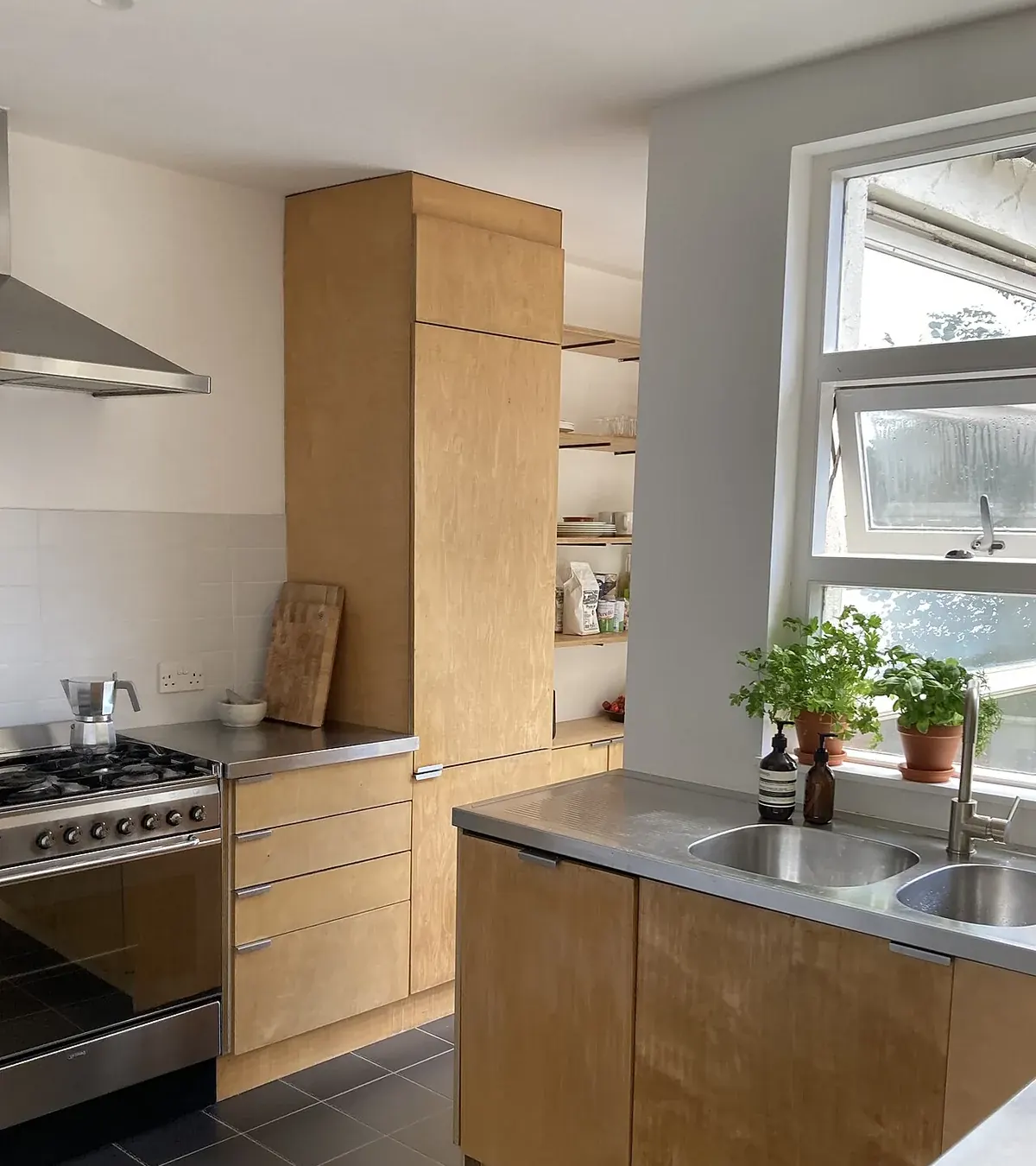
Boxes, doors and the order to decide them
Choose the box material first, because the box is what fails. Plywood holds a screw, resists racking when a heavy base is lifted and shimmed, and survives the slow supply line leak that eventually happens under every kitchen sink. Particleboard and MDF are flatter, cheaper and better substrates for paint and laminate, which is why even good cabinets use MDF for painted door panels, but once a particleboard sink base gets wet it swells and never recovers.
Door style comes second, and the price driver is machining rather than material. Slab doors are flat and cheapest. Shaker doors are a flat centre panel in a square edged frame and are the safe default across most of this housing stock. Raised panel doors add profiles to the centre and the frame edges, read more traditional, and hold more dust. Frame width and overlay, full or partial, move the number more than the style name does.
Interiors are what make a kitchen work
- Drawers instead of doors in base cabinets. A base with three drawers is usable to the back wall; a base with a door and a fixed shelf is not.
- A trash and recycling pull out beside the sink, sized for the bins the City of Santa Maria actually collects, rather than a cupboard with a bin on the floor.
- A corner solution. A blind corner with a pull out or a lazy susan beats the dead void behind a false front that most builder kitchens ship with.
- Full extension soft close slides. Three quarter extension leaves the back of every drawer permanently out of reach.
- A tall pantry, even a narrow one. In a kitchen with no walk in pantry, a 24 inch tall unit with roll outs replaces two uppers worth of usable storage.
- A deep drawer sized for pans, not a cupboard where the pans get stacked and scratched.
How the kitchen gets installed
Uppers go in before bases, so nobody is reaching across a finished counter. Before anything is hung, the crew finds the studs and strikes a level line off the highest point of the floor, because a kitchen floor is never flat and every base has to be shimmed up to the same plane. Boxes are screwed to studs rather than drywall and fastened to each other so the run behaves as one piece.
Counters come last. Stone and quartz fabricators template off the installed cabinets rather than off the drawing, which is why the counter appointment follows the cabinet install rather than running alongside it. Then the punch list: door alignment, drawer travel, scribe moulding where the run meets an out of square wall, toe kick, and fillers at the ends. More on installation, including install only jobs →
When a new kitchen is not the answer
If the boxes are square, dry and sound and the layout already works, refacing does the same visual job for a fraction of the money. Laminate refacing in Santa Maria runs $1,525 to $2,391 for a standard 12 cabinet kitchen according to homeyou's cost model for this city, about $127 to $199 per cabinet, against $500 to $1,400 per cabinet installed for custom replacement. Wood veneer refacing is estimated at $2,000 to $6,000 for the same kitchen.
The honest caveat is that refacing keeps your layout, your box sizes and your interior condition. If the particleboard under the sink has swelled, if face frames are racked, or if the layout is the actual complaint, refacing spends real money and fixes nothing. Compare refacing against replacement →
Kitchen cabinets across the Santa Maria Valley
The same kitchen work runs across Orcutt, Nipomo, Lompoc and Guadalupe, with the full coverage list on the service area page. If you want the broader picture first, the custom cabinets page covers materials, contracts and permits in more depth. When you are ready, request a written quote.